



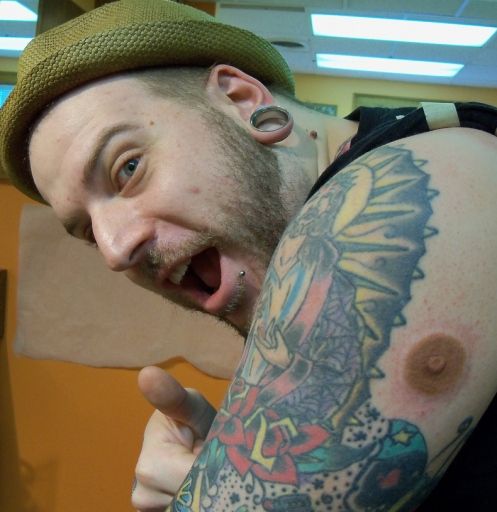
Realistic 3D tattoos turn human skin into a canvas of optical illusion. Unlike traditional styles that rely on bold black outlines and flat color fills, 3d nipple tattoo albuquerque uses directional lighting, smooth greywash gradients, cast shadows, and anatomical perspective to make designs appear as though they are hovering above the body, carved into the flesh, or emerging from beneath the epidermis.
1. Floating Butterflies and Lifelike Insects
Insects and arachnids are among the most convincing 3D tattoo designs because their delicate legs, thin wings, and compact bodies look natural resting on human skin.
-
The Visual Trick: Artists render the creature in hyper-detailed realism and place a soft, detached greywash drop shadow slightly offset beneath it. The narrow strip of bare skin between the insect and its shadow creates the illusion of an air gap, making a monarch butterfly, honeybee, or spider appear suspended millimeters above a shoulder or collarbone.
2. Biomechanical and Cybernetic Tear-Aways
Inspired by surrealist sci-fi art, biomechanical designs create the illusion that the wearer’s skin has been peeled, torn, or unzipped to reveal intricate machinery underneath.
-
The Visual Trick: Artists shade curled edges of torn skin with tight, dark inner shadows along the rim of the opening. Inside the recessed cavity, metallic gears, hydraulic pistons, copper wiring, and carbon-fiber plates are layered against deep black background shading. Placed over moving muscles like the deltoid, bicep, or calf, flexing the limb makes the internal components appear to shift.
3. Water Droplets and Morning Dew
Water droplets are a pure test of light refraction—a transparent subject painted entirely without color of its own.
-
The Visual Trick: To make water beads look wet on bare skin or flower petals, artists place a bright white specular highlight on the edge facing the imaginary light source, a soft crescent shadow inside the opposite curve of the droplet, and a crisp cast shadow on the skin just outside the rim.
4. Carved Stone Reliefs and Wood Engravings
Rather than popping outward, sculpted relief tattoos make the skin look as though a master mason or woodcarver chiseled intricate artwork directly into the body.
-
The Visual Trick: Designs featuring ancient stonework, compasses, skulls, or Celtic knots use sharp bevelled edges, directional rim highlights, and textured cracks. By shadowing the inner walls of each carved groove consistently from one light angle, the design gains convincing physical depth.
5. Trompe-l’œil Optical Illusions and Sunken Grids
Derived from the French term meaning “deceive the eye,” trompe-l’œil tattoos use architectural perspective and geometric distortion to alter the perceived shape of an arm, leg, or chest.
-
The Visual Trick: Warped checkerboards, honeycomb lattices, and impossible staircases rely on strict vanishing points and progressively darkening black gradients. As the geometric lines converge inward, a solid forearm or chest can suddenly appear hollowed out into an endless tunnel.
6. Stitched Skin, Ribbons, and Laced Corsets
Tattoos that interact directly with punctured skin create a striking tactile illusion.
-
The Visual Trick: Surgical sutures, leather laces, or satin ribbons are rendered weaving in and out of realistic skin eyelets. Tiny, dark puncture shadows at every entry and exit point—combined with subtle tension creases in the surrounding skin—make the lacing look physically threaded through the dermis.
7. Hyper-Realistic Florals and Coiled Wildlife
Botanical and animal subjects achieve three-dimensional presence through foreshortening and depth-of-field blurring.
-
3D Roses and Lilies: Overlapping petals cast soft shadows onto the layers beneath them, while curled outer petal tips catch bright highlights, making the bloom appear to open outward from the skin.
-
Coiled Snakes and Emerging Predators: A serpent wrapped around a forearm uses the limb’s natural circumference to sell the illusion, casting a continuous shadow along the skin as its scales catch overhead light.
What Makes a 3D Tattoo Truly Convincing?
-
One Unified Light Source: Every highlight and shadow across the entire design must obey the exact same imaginary light angle; conflicting shadows immediately break the illusion.
-
Deep Black Contrast: Without saturated black ink anchoring the shadow zones, bright highlights cannot visually pop forward.
-
Custom Anatomical Mapping: The best 3D tattoos are stenciled directly onto the natural curves of the body rather than copied from flat templates, allowing muscle contours to enhance the perspective.