




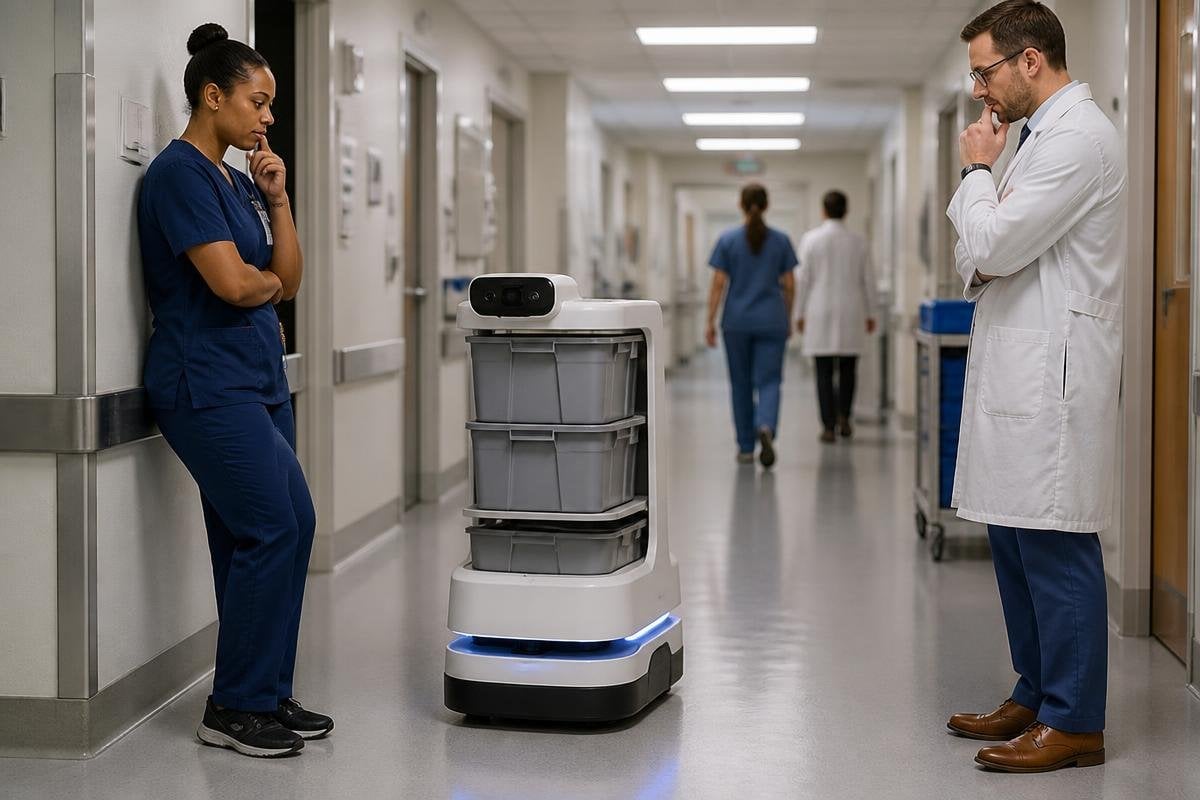
A hospital robot may move supplies, guide visitors, or support surgery, but its work sits inside a system built around people, rules, and patient safety.
The hardest part is rarely making the robot move. It’s fitting that movement into a busy care setting without adding work for staff.
- Safe operation must fit clinical routines
- Data, software, and equipment need to work together
- Hospitals need a clear reason to pay, train, and maintain the system
Safety comes before speed
Robots in hospitals share space with patients, visitors, nurses, porters, and cleaning staff. They need to detect people, stop when a route changes, and behave in a way that staff can predict.
That becomes harder near beds, lifts, doors, and crowded corridors. A robot that works well on a marked route may still need help when a meal cart blocks its path or a patient suddenly steps into the corridor. The hospital must set rules for those cases before the system starts work.
Clinical work adds another layer. A robot carrying medicine or laboratory samples needs clear handoff steps, access controls, and a record of what it moved. The machine can perform the trip, but people still need to check the process around it.
Hospital systems rarely speak the same language
A delivery robot may need information from a hospital’s scheduling software, lift controls, doors, and stock system. If those systems cannot exchange data, staff may have to enter the same request more than once.
That extra work can erase the time saved by automation. It can also create mistakes when a room number changes, a lift is busy, or a delivery must go to a different ward.
The problem reaches beyond software. Hospitals have many old machines and building systems, each with its own controls and limits. A robot may need new network access, charging space, floor markings, locked storage, or changes to corridor use. Those changes cost money before the first task runs.
Before staff change their routine, buyers need to know whether a robot has worked in a real ward, with corridor delays, lift access, and human handoffs. A dated hospital trial reported by Robot24.com can tie those details to the machine and task being tested. The next question is whether staff see enough value to use it.
Staff need a reason to use it
A robot can be useful on paper and still fail in daily work if staff see it as another system to manage. Nurses may need to load it, clear its route, respond to alerts, or report faults. Those steps must fit the shift, or the robot will sit unused during the busiest hours.
Training also needs a clear owner. A ward manager may handle daily use, while an engineering team manages faults and an outside supplier handles software updates. If nobody owns a problem, a small fault can stop the task for days.
Staff concerns deserve direct answers. They may ask if the robot will change their jobs, who sees its camera data, and what happens when it fails. A hospital that cannot answer those questions will have trouble getting steady use from the system.
The business case is hard to prove
Hospitals need to count the full cost, not only the purchase price. That includes site changes, software work, training, service visits, batteries, cleaning, and downtime.
The benefit can also be difficult to measure. A robot may reduce walking for staff, but that time does not always become a direct cash saving. It may free staff for patient care, reduce repeated trips, or keep supplies moving at night. Those effects matter, yet they need a clear way to measure them.
A small trial can give useful evidence, but a trial route may be easier than the wider hospital. The open question is what happens when more wards, more lifts, and more staff depend on the same robot.
A practical buying check
Before approving a hospital robotics project, ask:
- Name the task: Set the repeated job and the person who owns the result.
- Map the route: Where will people, beds, carts, doors, and lifts affect its work?
- Check the handoff: Who loads, receives, cleans, and checks each delivery?
- Price the site: What network, charging, door, lift, and storage changes are needed?
- Set failure rules: What happens when the robot stops, loses data, or needs help?
- Measure the trial: Which time, error, safety, or staffing result decides expansion?
Hospitals should start with a narrow task that has a clear owner and a clear measure. I’d skip any project that cannot say who handles failure and how the hospital will judge the result.
The next useful hospital robot won’t be the one with the longest feature list. It will be the one that completes a defined task through a full shift, with staff knowing what happens when the route breaks.
